
Fire safety is a legal duty for every business in Newcastle upon Tyne. As a business owner, landlord or responsible person, you must assess your risks and put suitable protection in place. Fire extinguishers form a key part of that protection. They allow trained staff to tackle small fires quickly and safely before they spread.
At Expert Fire Solutions, we regularly work with offices, shops, warehouses, schools, hospitality venues and residential blocks across Newcastle. One of the most common questions we hear is simple. Which fire extinguishers do I actually need?
The answer depends on your building, the activities you carry out and the materials you store. In this guide, we explain the main types of fire extinguishers, what each one is designed for and how to decide what your Newcastle business requires.
Why Choosing the Right Fire Extinguisher Matters
Not all fires are the same. A fire involving paper or wood behaves very differently from one involving cooking oil or electrical equipment. If you use the wrong extinguisher on the wrong type of fire, you can make the situation worse and put people at risk.
UK fire safety law requires you to provide appropriate firefighting equipment where necessary. This means you must match the extinguisher to the risk. A general approach is not enough. You need to consider your specific premises in Newcastle and the hazards present within them.
When we carry out fire risk assessments, we look at factors such as:
- The size and layout of the building
- The type of business activities
- The number of occupants
- The presence of electrical equipment
- The use of flammable liquids or gases
- Kitchen facilities and cooking processes
From there, we recommend extinguisher types and quantities that meet both legal requirements and practical safety needs.
Understanding Fire Classes
Before looking at extinguisher types, it helps to understand the different classes of fire recognised in the UK.
Class A fires involve solid materials such as wood, paper, cardboard and textiles.
Class B fires involve flammable liquids such as petrol, paint and solvents.
Class C fires involve flammable gases such as propane and butane.
Class D fires involve combustible metals, though these are less common in typical commercial settings.
Electrical fires involve live electrical equipment.
Class F fires involve cooking oils and fats, usually found in commercial kitchens.
Each extinguisher is designed to deal with one or more of these fire classes.
Water Fire Extinguishers
Water extinguishers are the most common type in many workplaces. They are designed for Class A fires involving materials such as paper, wood and textiles.
In an office in Newcastle city centre, for example, most fire risks involve desks, paperwork, furnishings and general waste. In these environments, water extinguishers are usually suitable as a base level of protection.
Water extinguishers work by cooling the burning material and reducing the temperature below the point at which it can continue to burn.
However, water should never be used on electrical fires or flammable liquids. Using water in these situations can cause electric shock or spread the fire.
We often recommend water extinguishers in offices, schools, retail units and communal areas of residential buildings across Newcastle where the main risk is Class A materials.
Foam Fire Extinguishers
Foam extinguishers are versatile and suitable for both Class A and Class B fires. This makes them a strong option for businesses that handle flammable liquids.
Foam works by forming a blanket over the surface of a burning liquid. This cuts off the oxygen supply and helps prevent re ignition.
In Newcastle workshops, garages, warehouses or industrial units where small quantities of fuel, paint or solvents are present, foam extinguishers are often appropriate.
They can also be used on solid materials, which means they offer broader protection than water alone. However, like water extinguishers, they are not suitable for use on live electrical equipment unless specifically tested and approved.
If your business stores or uses flammable liquids, foam extinguishers may be necessary to meet your legal obligations.
CO2 Fire Extinguishers
Carbon dioxide, known as CO2, extinguishers are primarily used for electrical fires and some Class B fires.
CO2 works by displacing oxygen around the fire, effectively suffocating it. It leaves no residue, which makes it ideal for use around sensitive electrical equipment.
In Newcastle offices with server rooms, IT suites or large numbers of computers, CO2 extinguishers are typically required. We also install them in retail premises with electrical tills and display systems.
Because CO2 does not leave a residue, it reduces damage to equipment. This can be important for businesses that rely heavily on technology.
However, CO2 is not suitable for Class A fires involving solid materials. It does not cool the fire in the same way as water or foam, so re ignition can occur if the source remains hot.
For most commercial premises in Newcastle, we recommend pairing CO2 extinguishers with water or foam units to ensure full coverage.
Dry Powder Fire Extinguishers
Dry powder extinguishers are highly effective and can tackle Class A, B and C fires. They are sometimes referred to as multipurpose extinguishers.
Powder works by interrupting the chemical reaction of the fire. It can deal with flammable gases and liquids, making it useful in certain industrial settings.
However, powder extinguishers have limitations. They create a cloud of fine powder when discharged, which can reduce visibility and cause breathing difficulties in enclosed spaces. The residue can also damage equipment and require extensive cleaning.
For this reason, we do not usually recommend powder extinguishers for offices, shops or indoor public areas in Newcastle unless there is a specific need, such as flammable gas storage.
They are more commonly used in outdoor environments, construction sites or specific industrial applications.
Wet Chemical Fire Extinguishers
Wet chemical extinguishers are designed for Class F fires involving cooking oils and fats. They are essential in commercial kitchens.
In Newcastle restaurants, takeaways, hotels and catering facilities, wet chemical extinguishers are a legal and practical necessity. They work by creating a soapy layer over burning oil, cooling it and preventing re-ignition.
Standard water or foam extinguishers are not safe for use on deep fat fryers. Using the wrong extinguisher in a kitchen can cause serious injury and spread the fire rapidly.
If your business includes a commercial kitchen, we will normally recommend at least one wet chemical extinguisher, positioned close to the cooking area but not so close that it becomes inaccessible in a fire.
How Many Extinguishers Does Your Newcastle Business Need?
The type of extinguisher is only part of the picture. You must also consider quantity and placement.
General guidance suggests that for Class A risks, you should provide a minimum water equivalent based on floor area. In practical terms, this often means at least two water or foam extinguishers per floor in small to medium premises.
Extinguishers should be:
- Clearly visible and accessible
- Positioned on escape routes
- Located near exits
- Mounted at the correct height
In larger buildings across Newcastle, such as multi storey offices or industrial units, the layout will influence the number and positioning required. We assess travel distances so that no one has to walk too far to reach suitable equipment.
Do All Newcastle Businesses Need the Same Setup?
No. A small office in Jesmond will have very different needs compared to a manufacturing site in Team Valley or a restaurant on the Quayside.
For example:
An office may require water extinguishers for general materials and CO2 for electrical equipment.
A retail shop may need foam for mixed risks and CO2 for electrical points of sale systems.
A warehouse storing flammable liquids may require foam or powder in addition to water.
A restaurant will require water or foam for general areas, CO2 for electrical equipment and wet chemical for the kitchen.
We always base our recommendations on a site specific assessment rather than assumptions.
Ongoing Maintenance and Servicing
Providing the correct extinguishers is only the first step. You must also maintain them.
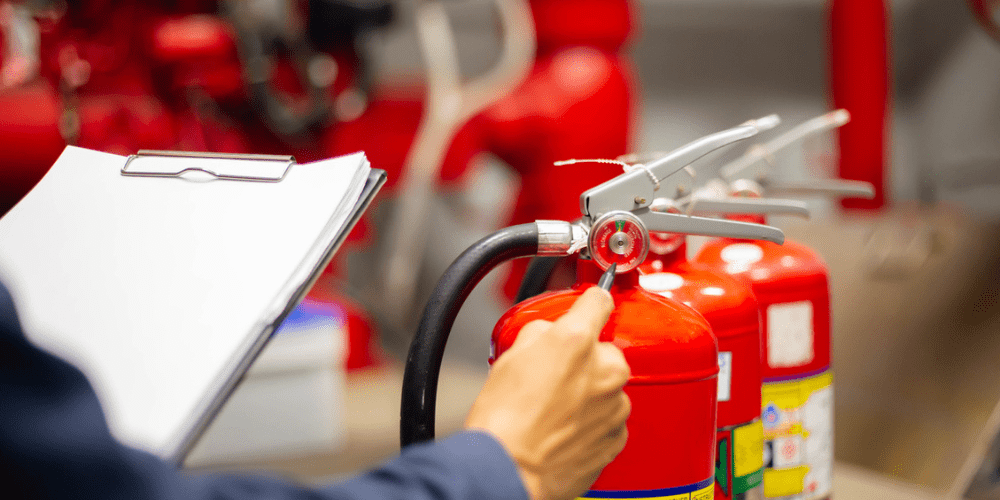
UK standards require annual servicing by a competent person. In addition, you or a member of staff should carry out regular visual checks to ensure:
- The extinguisher is in place
- The pressure gauge is in the correct zone
- There are no visible signs of damage
- The safety pin and tamper seal are intact
At Expert Fire Solutions, we provide fire extinguisher servicing in Newcastle upon Tyne to ensure your equipment remains compliant and ready for use.
Getting Expert Advice for Your Newcastle Business
Choosing the right fire extinguishers is not about guessing. It is about understanding your risks and meeting your legal responsibilities.
We work with businesses across Newcastle to assess their premises, recommend appropriate equipment and ensure full compliance with current regulations. We take a clear and practical approach, explaining exactly what you need and why.
If you are unsure whether your current extinguishers are suitable, or if you are setting up a new premises in Newcastle upon Tyne, we can help.
Contact Expert Fire Solutions today to arrange a fire risk assessment or extinguisher survey. We will ensure your business has the right protection in place to keep your people, property and livelihood safe.

